

We’re going to continue to increase your…
…time, money, energy & creativity while we prepare to execute in the most effective and efficient ways possible as it relates to your ability to affect immediate and long term change in your life, as well as in the lives of others.
We’ll be doing this by approaching the art of prioritization in a very unique and specific way.
You see. When you design your priorities with intent,
…it allows you to move at the kinds of velocities that produce the abundant rates of return you need to move from one strategy to the next without fatiguing.
Now when I say “Prioritization” that doesn’t mean importance. In the context of discovering as well as living out your purpose, prioritization is all about power.
The Steps
Prioritizing by power is the act of taking out the immediate targets by labeling and organizing them in ways that produce the most amounts of deployable time, energy, creativity and currency.
When you’re done with this phase you will have a total of 6 elements prioritized (this will make sense soon).
Prioritize Three: 1 Now
Prioritize Three: 2 Next
⬇️ It will look similar to the map below ⬇️
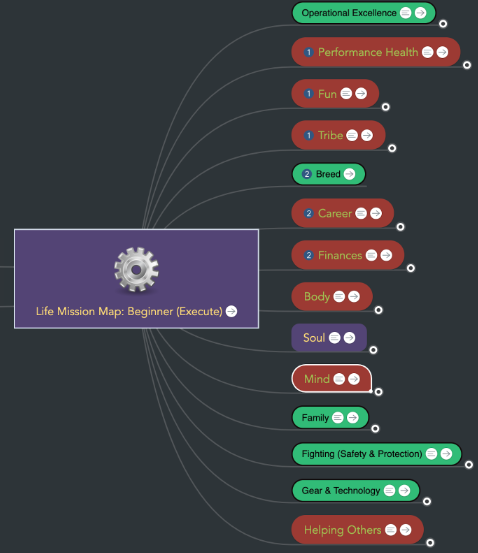
As you progress, you’ll begin to develop a…
…personal set of preferences in regards to color, shapes and organization. For me this has changed over the years, but what is important is that you arrange your map in ways that keep you present to your current and future situation(s). It’s your linguistic filter. Not anybody else’s.
You can see in this map I organized the “1 Nows” at the top, and sequenced the “2 Nexts” below. Rearranging them after I’ve prioritized them also gives me another way of looking at things, which helps me refine my prioritization.
Also If you look closely, you’ll notice how by executing from top to bottom, power will build up and cascade down from one strategy to the next.
For instance, if I get my “Performance Health” handled,
I’ll be a sharper and more energized human.
Then if I handle fun in my life, I’ll have flow states, harmony and something to build a tribe around.
Then I build my tribe, so that I have a support network to hold me accountable and put things like performance health and fun on auto pilot.
Then I can take all of that power, passion, and additional help into things like career and finances.
Step One: Should – Want – ROI
In order, ask yourself each question below while passing through and prioritizing the elements on your map.
[_] What do I think SHOULD be done first?
→ Review your map with this question in mind and select 3 things to label “1: Now” by using the numbered icons.
[_] What do I WANT to do first?
→ Review your map with this question in mind and select 3 more things to label “1: Now” by using the numbered icons.
You can choose the same three things you’ve already labeled as a “1 Now”, or you can label three more things as “1 Now”.
Don’t worry if you have too many “1 Nows” right now. We’ll clean that up as we go.
[_] What WOULD produce a positive ripple across other parts of my life?
Review your map with this question in mind and select 3 things to label “1: Now” by using the numbered icons.
Again… This can be three more things or the same things you’ve already selected.
[_] What WOULD produce an early return on the time, energy, creativity and currency I put into it?
Review your map with this question in mind and select 3 things to label “1: Now” by using the numbered icons.
Again… This can be three more things or the same things you’ve already selected.
[X] Step One Complete:
At this point you should have between three to twelve “1: Nows” indicated on your map by the numbered icon.
Step Two: Narrow Your Focus
[_] If after completing Step One IF you only have three elements labeled “1 Now”, then skip to step 3.
If you have more than three “1 Nows” then let’s keep refining and bring things into a tighter focus.
[_] Now simply pick three “1 Now’s” and three “2: Next’s” and clear the other numbered icons from the rest.
Yes – I know that just happened so fast and that it sounds too simple, but I also know two things that you don’t yet know.
First: By this point alone, you’re likely a thousand times more aware and organized in regards to life priorities than you were yesterday. So, we’re already doing much better. Relax.
Second: This Life Mission Map is one structure out of several. Each structure has its own impact on the Identify – Assess – Prioritize by Power & Execute formula.
Each time you use one, it’s very likely you’ll modify your assessments and prioritizations.
These iterations are what makes you into the type of self that master life and lead others to do the same.
This iteration process is by design:
You’re going to see your commitments, priorities and action plans from about 20 different angles and perspectives.
For a period of time, not forever, but for a period of time, these assessments and priorities will wiggle, squirm, and try to run and modify themselves. It’s just your biology and psychology trying to avoid any real change in your life.
This reaction is both normal and good. It’s good because once they settle and stick, you’ll be able to hold practices and habits like you’ve never been able to before because you’ll trust your assessments and prioritization’s, because you did the work, wrestled it, reviewed it and repeated it.
[X] Step Two Complete:
At this point you should have three “1: Nows” and three “2: Nexts” indicated on your map by the numbered icon.
The Results
When you unshackle prioritization from importance, we access new unknown and untapped sources of power.
We change our thinking from a “Yes BUT” mentality to a “Yes AND” mentality.
There is no more of this:
→ “I need to make more money BUT I have kids.”
→ “I need to get in shape BUT my work schedule is demanding.”
You’re now able to free yourself by changing that kind of language to:
→ “I need to make more money AND I need to teach my kids how to live lives of passion and purpose.”
→ “I need to get in shape AND my work schedule is demanding.”
Before you go, I want you to understand what you now have.
A tuned linguistic filter. You’ll be ignoring that which is currently irrelevant and only capturing the things that will change your life as well as the lives of those you love and lead. You now have a lot less to worry about.
I find that when people approach life this way, they become energized because they are no longer looking at aspects of their lives as time sucking and attention taking “Things to do” that are causing them anxiety;
but, they begin to see them as future sources of energy and power.
Our paradigm shifts from being a reactor, to a creator, or from a victim, to a hero.
You are now ready to take actions. To execute.
Responses
You must be logged in to post a comment.
1: Why do you believe the below claim can be true?
“You’ll be able to hold practices and habits like you’ve never been able to before because you’ll trust your assessments and prioritization’s, because you did the work, wrestled it, reviewed it and repeated it.”
It is me who did it: I did the work, wrestled it, reviewed it and repeated it.
In other words, I’ve assumed the responsibility for my own life.
I know well how I’ve done all of this. If I’ve done it well, with full focus, drive, and concentration, I can trust my assessments and prioritizations. And if I can trust them, I’m able to hold these practices and habits.
Maybe this could be called freedom: the realization of my responsibility for my own life. If I understand how much things in my life I’m able to do by myself (with all consequences) instead of waiting for things to be done (somehow) by someone else, I realize how much things in my life I can change and improve in fact.
1: Why do you believe the below claim can be true?
“You’ll be able to hold practices and habits like you’ve never been able to before because you’ll trust your assessments and prioritization’s, because you did the work, wrestled it, reviewed it and repeated it.”
You trust what you’ve pressure-tested.
In martial arts, forms become real when they’re applied — not just rehearsed. The same is true here. I’ve gone through the assessment and prioritization process, not once, but through a few rounds of honest iteration. That builds a kind of internal alignment — not just intellectually, but in the body. You start to feel which priorities hold up under stress, and which don’t.
That doesn’t mean the trust is absolute yet. Deep trust comes through continuous repetition and practice. Wrestling with the choices, refining them, and seeing them start to work — that’s what lets habits lock in. It stops being about motivation and becomes about rhythm.
This process builds that rhythm. That’s why I believe I’ll be able to hold practices and habits like never before — not because they’re easy, but because they’re mine, forged through work I can stand behind.
QUESTION #1: Why do you believe the below claim can be true?
“You’ll be able to hold practices and habits like you’ve never been able to before because you’ll trust your assessments and prioritization’s, because you did the work, wrestled it, reviewed it and repeated it.”
ANSWER #1: I believe this claim is true because trust in yourself, your process, and your plan is a byproduct of embodied ownership. When we wrestle with our assessments instead of borrowing someone else’s, when we review them instead of rushing to completion, and when we repeat them through multiple filters (SHOULD, WANT, RIPPLE, ROI), something fundamental shifts: We stop reacting to life with guilt-driven urgency and start creating from clarity-fueled intention.
In that state, practices and habits are no longer imposed, they’re chosen. Something my dad used to tell me was this: “You either choose the cost or you pay the price.” The same dichotomy holds true between a hero and a victim. They aren’t items on a to-do list; they’re systems we believe in, because we built them ourselves, or we didn’t.
This is different from motivational hype or fleeting willpower. This is internal congruence. The reason we’ll be able to hold practices and habits “like we’ve never been able to before” is because we’re no longer doubting whether we’re doing the right things—we’ve already proven to ourselves that they are the right things, for us, now, with evidence.
In short, the process creates the proof. And proof produces trust. And trust produces follow-through.
That’s why this is not just about “being more disciplined,” it’s about becoming the kind of person who no longer needs to second-guess or start over. Because your habits are now a reflection of your self-authored path, and not borrowed obligation.
That’s why the claim holds. So, what does that produce? Confidence. Clarity. Conviction. And from that comes consistency.
Now, when you wake up and go to the gym, or plan your finances, or block time to build a tribe you’re not just doing it out of obligation. You’re doing it because it’s been strategically selected as a power lever in your life.
That’s why the claim holds. Because you’ll hold your practices because they now hold meaning.
And meaning sticks.
1: Why do you believe the below claim can be true?
“You’ll be able to hold practices and habits like you’ve never been able to before because you’ll trust your assessments and prioritization’s, because you did the work, wrestled it, reviewed it and repeated it.”
When someone else tells you what they think you should do, the impetus for change is coming from the outside. When you do the work to assess your own unique personal situation and determine what to prioritize, the motivation for action and transformation comes from within.